
The Reserve Bank of India is expected to keep policy unchanged this week as it looks to control inflation.

From the Sensex pack, Bajaj Finserv, Larsen & Toubro, Bajaj Finance, HDFC Bank, Bharat Electronics and Kotak Mahindra Bank were among the major laggards. However, Tata Steel, Asian Paints, UltraTech Cement, and Trent were the biggest gainers.

Growth in India's manufacturing sector cooled to its slowest in 22 months in October.

The Nikkei Markit India Manufacturing Purchasing Managers' Index (PMI) -- a gauge of manufacturing performance -- fell to 52.3, down from October's 22-month high of 54.4.

Bajaj Finance, IndusInd Bank, State Bank of India, Maruti, Tata Motors, ITC, Tata Steel and Reliance Industries were also among the gainers. Nestle, NTPC, Kotak Mahindra Bank, Power Grid and Titan were among the laggards.

From the Sensex firms, Tech Mahindra, Tata Steel, Tata Motors, Titan, HDFC Bank, IndusInd Bank, Infosys and Kotak Mahindra Bank were among the biggest laggards. On the other hand, Adani Ports, Mahindra & Mahindra, Power Grid, Eternal and Hindustan Unilever were among the gainers.

According to Japanese financial services major Nomura, India's manufacturing PMI remained in the expansion zone but suggested some consolidation after the rapid ramp up of activity in December.

The Nikkei India Manufacturing Purchasing Managers Index (PMI), fell from 52.1 in February to a five-month low of 51.0 in March, indicating the slowest improvement in operating conditions recorded by the survey since last October.

The Nikkei Markit India Manufacturing Purchasing Managers' Index increased to 50.7 in February

On the price front, Indian manufacturing companies continued to face higher input costs during August.

This is the 14th consecutive month that the manufacturing PMI remained above the 50-point mark. In PMI parlance, a print above 50 means expansion, while a score below that denotes contraction.
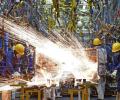
This is the ninth consecutive month that the manufacturing PMI remained above the 50-point-mark.

Reflecting a loss of "growth momentum", manufacturing activities in the country slowed down to a six-month low in March amid softer increases in new orders, production and employment, according to a survey.

The Nikkei India Manufacturing Purchasing Managers' Index (PMI) stood at 47.9 in July, down from 50.9 in June, its lowest mark since February 2009, and highlighted the first deterioration in business conditions in 2017 so far.

Firms seem to have adopted a wait-and-see approach on their plans until public policies become clearer upon the formation of a government.

This is the 22nd consecutive month that the manufacturing PMI has remained above the 50-point mark.
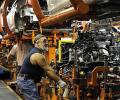
Regarding employment, the manufacturing sector hiring remained broadly unchanged.
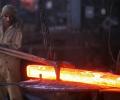
The Nikkei Markit India Manufacturing Purchasing Managers' Index (PMI) -- an indicator of manufacturing activity -- fell to 49.6, down from 52.3 in November, coming below the crucial 50 threshold which separates contraction from expansion.

The Nikkei India Services Purchasing Managers' Index (PMI), which tracks services sector firms on a monthly basis, stood at 48.7 in January, as against 46.8 in December 2016.

A reading above 50 indicates expansion, while a score below this mark means contraction

The main factors contributing to the above-50.0 PMI reading were growth of both new orders and output as market conditions returned to normal and led to subsequent improvement in demand.

The Nikkei Markit India Manufacturing Purchasing Managers' Index (PMI) -- an indicator of manufacturing activity -- declined from 52.5 in April to a three-month low of 51.6 in May.
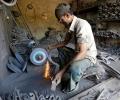
Supported by greater demand from both domestic and external markets, total new business rose at the fastest pace since March

A reading above 50 denotes expansion while one below means contraction.

In the Sensex pack, Tata Motors was the biggest loser, shedding 3.29 per cent, followed by ICICI Bank, IndusInd Bank, Infosys, HCL Tech, Axis Bank, TCS, HUL, Asian Paints, Sun Pharma, SBI, Tata Steel and NTPC, which dropped up to 3.23 per cent.

Input prices rose at their fastest rate in 14 months but manufacturers absorbed much of the increase

During March, the rate of inflation slowed to the weakest in four months and was below the long-run survey average

TCS was the top gainer in the Sensex pack, rising around 2 per cent, followed by ONGC, SBI, L&T, Infosys, HCL Tech, ICICI Bank and Axis Bank. The broader NSE Nifty surged hit a record high of 14,109.40.

The NSE Nifty gained 77.85 points, or 0.71 per cent, to finish at 11,008.30. Intra-day, it shuttled between 10,821.55 and 11,035.65.
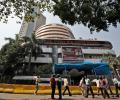
Sentiments turned somewhat weak towards the middle of the session as profit-booking emerged as investors turned cautious on disappointing quarterly earnings by some bluechip companies

Losses largely came from the metal index, followed by power, infrastructure, realty, PSU, oil and gas, capital goods, FMCG, healthcare, auto and banking.

Market sentiment suffered a jolt after other Asian markets closed with widespread losses and European markets dropped in early trade

The biggest losers in the Sensex pack were Vedanta, Tata Steel, M&M, Tata Motors, Maruti, Hero MotoCorp, PowerGrid, Bharti Airtel, SBI and Coal India -- falling up to 4.48 per cent.
The Nikkei India Services PMI posted above the critical 50.0 level, which separates growth from contraction, for the fourth month running in May.

The survey noted that advertising campaigns supported the increase in new work growth in the sector amid competitive pressures.
The improvement in business conditions promoted job creation, while confidence towards the year-ahead outlook for activity was at a four-month high during March.

With factory production, activities across the private sector saw the biggest drop in over three years

Currency scarcity weighed on manufacturing performance where growth of new work flows slowed
While manufacturing firms cut jobs for the first time in 20 months to sharply reduce costs, services providers continued their hiring spree.

Firms hired additional hands to keep up with the production demand
 © 2026 Rediff.com - Advertise with us - Disclaimer - Privacy Policy - Sitemap - Feedback - About us - Terms of use - Grievances